
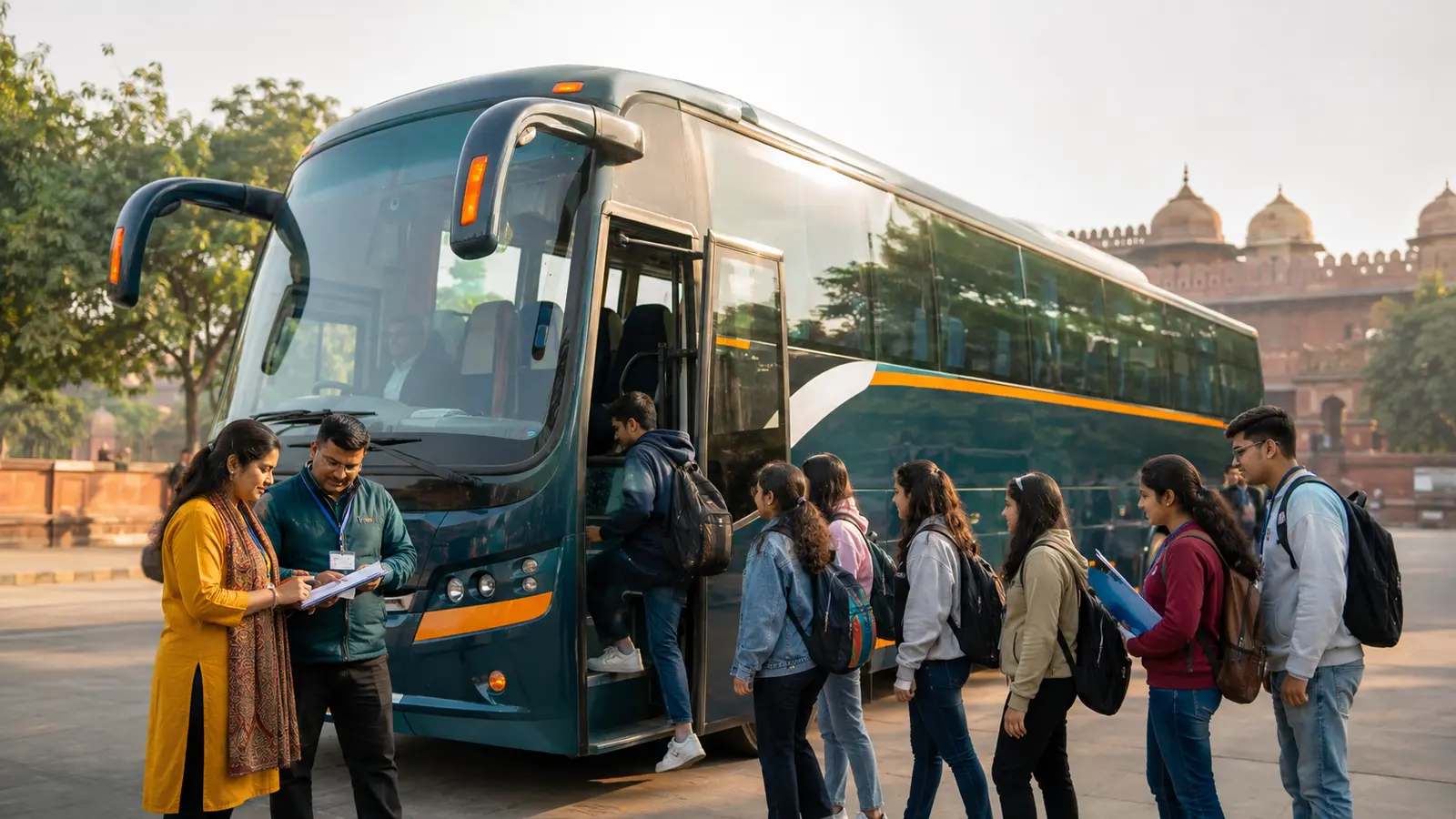
A successful educational trip begins before the bus starts. Clear responsibility, an appropriate vehicle, a realistic route and calm supervision create the conditions for students to learn and enjoy the journey.
Educational travel can turn a lesson into a lasting memory. A museum visit, heritage walk, science centre, industrial tour, competition, sports fixture or multi-day excursion gives students experiences that a classroom cannot fully reproduce. The transport plan carries a special responsibility because schools and colleges are moving a supervised group with fixed schedules, different needs and expectations from families.
Choosing a bus rental for school and college trips in Delhi should therefore involve more than comparing seat counts and prices. Institutions need to consider vehicle suitability, route timing, adult supervision, attendance procedures, boarding points, comfort, emergency communication and current regulatory requirements. This guide provides a practical framework for administrators, teachers, trip leaders and student coordinators planning group travel from Delhi NCR.
Define the Educational Trip Clearly
Start with the purpose, destination and participant profile. A half-day visit for younger students has different transport needs from an inter-college competition or a three-day tour for university students. Record the date, reporting time, destination, expected return, age group, student count, staff count and luggage requirement.
Identify whether the bus will remain with the group, complete a drop-and-return movement or operate between several sites. For an industrial visit, the coach may wait outside the facility. For a heritage day, it may move between monuments. For a sports team, equipment space matters. The full duty plan should be shared before requesting a quotation.
Match Capacity to Students, Staff and Equipment
Every supervising adult occupies a seat, and bags or equipment may require additional space. Count students, teachers, support staff and any accompanying medical or administrative personnel. Then list backpacks, overnight luggage, sports kits, instruments, project material or mobility aids.
A vehicle should not be planned at uncomfortable maximum capacity. Spare seating can support supervision, distribute equipment and reduce congestion during boarding. Depending on the group, Ajay Travels offers links to several fleet categories:
- Tempo Traveller on rent for small academic teams, faculty groups or compact project visits
- 18-seater coach for small supervised groups
- 27-seater coach and 35-seater coach for medium educational trips
- 41-seater coach and larger options for full class or multi-section movement
- The wider bus and coach rental fleet for large or multi-vehicle requirements
The institution should review the final vehicle choice against its own policies and all current transport requirements applicable to the trip.
Use a Written Safety and Suitability Checklist
A safety-first conversation should be specific. Ask about vehicle documentation, routine checks, driver assignment, emergency contact and substitution procedure. Before departure, the trip leader can check visible basics such as tyres, steps, doors, windows, seating condition, lighting, first-aid provision and emergency access according to institutional policy.
Regulations and institutional obligations can change, and requirements may differ by trip type or jurisdiction. Schools and colleges should confirm current rules with the appropriate authorities and their own administration. The transport supplier supports the movement, while the institution retains responsibility for approvals, student consent, supervision and compliance.
Pre-departure transport checklist
- Approved student and staff list
- Parent or guardian permissions where required
- Vehicle and driver details reviewed by the institution
- Route, stops and expected timings confirmed
- Emergency and school escalation contacts available
- Attendance process assigned to named staff
- Medication, accessibility and dietary notes handled appropriately
- Weather and destination access checked
- Current permissions and regulatory requirements confirmed
Plan Adult Supervision by Vehicle
Each vehicle should have a named trip leader and an agreed number of supervising adults based on student age, institutional policy and trip complexity. Divide responsibility rather than assuming all staff will monitor everything. One teacher can hold the master attendance list, another can supervise the rear section, and another can manage communication with the destination or school office.
For multiple buses, appoint one overall transport coordinator plus a lead adult in every vehicle. Give each lead the driver and coordinator contact, route, stop plan and student list for that bus. Avoid moving students between vehicles after departure unless the central list is updated.
Make Attendance a Repeatable Procedure
Attendance should be recorded at school before boarding, after every major stop and before the return departure. Use the same list and the same roll-call method. A buddy system may provide additional awareness, but it should not replace adult verification.
Students should know which bus they are assigned to and should not swap vehicles informally. For large trips, use simple vehicle identifiers such as Coach A, Coach B and Coach C. Coloured cards, wristbands or group lists can help without placing personal information in public view.
Choose Safe, Controlled Boarding Points
The best departure point is usually inside the school or college campus where space allows. If roadside boarding is unavoidable, select a location with enough space for the coach to stop without creating dangerous crossings or traffic conflict. Staff should arrive before students and create a clear waiting area away from the moving vehicle.
Board in an orderly sequence, load large luggage separately and keep the vehicle aisle clear. Students should not gather around the bus while it is manoeuvring. At the destination, staff should exit first when appropriate and guide students to the assembly point.
Build a Realistic Route and Schedule
Educational itineraries often become too ambitious. A plan with several distant attractions may spend more time in traffic than at the learning sites. Consider Delhi NCR peak hours, entry timings, coach parking, security checks, meal breaks and walking distances. Work backward from fixed appointments such as a factory tour, museum slot or competition reporting time.
Add a sensible buffer but avoid extremely early reporting without need. Fatigue can affect the experience, especially for younger students. For outstation trips, plan rest stops at appropriate locations and provide families with realistic departure and return windows rather than promising an exact minute that road conditions cannot guarantee.
Comfort Supports Better Behaviour
Comfort is not a luxury on a supervised journey. Effective air-conditioning, clean seats, a clear aisle and suitable journey breaks help students remain settled. Select capacity that reduces crowding and allows staff to move or communicate when needed.
Set simple bus rules before departure: remain seated while the vehicle is moving, keep aisles clear, store bags safely, avoid distracting the driver and follow staff instructions at stops. Explain the reason for each rule. Students are more likely to cooperate when expectations are clear and consistent.
Prepare for Weather and Air Quality
Delhi travel plans can be affected by heat, winter fog, rain and poor visibility. Check forecasts and official advisories before the trip. Carry drinking water as appropriate, adjust departure time when conditions require and ensure clothing guidance matches the destination. A trip should be postponed or modified when the institution determines that travel conditions are unsuitable.
For long journeys in fog-prone periods, build conservative timing and avoid pressure to “make up” delays. Safety must remain more important than the original schedule.
Communication with Parents and Students
Send one concise trip note containing reporting time, return window, destination, emergency school contact, required clothing, food arrangements and permitted luggage. Transport details should be accurate but not expose unnecessary personal or driver information to broad groups.
During the trip, updates should come from the authorised school coordinator. A departure confirmation and a revised estimated arrival can reassure families without creating constant messaging. If the return is delayed, state the reason in simple terms and provide the next update time.
Planning College Tours and Industrial Visits
College groups may have greater independence, but the movement still needs structure. Confirm participant names, faculty leads, institute permissions and destination reporting requirements. Industrial sites may require identity documents, safety clothing or strict entry slots; allow time for these checks.
For multi-day college tours, choose vehicles based on long-distance comfort and luggage, not only price. Review hotel access, night travel policy, driver scheduling and rest stops. A Volvo coach may be considered for higher-comfort group routes, while medium groups may prefer a 27- or 35-seater coach.
Prepare a Simple Incident and Delay Plan
A plan does not need to imagine every possible problem. It should define who makes decisions and how people communicate. Record the institution’s emergency contact, transport provider’s escalation number, nearest appropriate support point and procedure for medical or vehicle issues. Staff should carry essential participant information securely and use it only when necessary.
If a vehicle substitution is required, students should remain under staff supervision while details are verified. Do not accept unplanned changes without the responsible school or college coordinator’s approval.
How to Request and Compare Quotations
Provide travel date, reporting time, exact pickup, destinations, route, student and staff counts, luggage, waiting time and return plan. Mention whether the requirement is local, outstation, same-day or multi-day. Ask the quotation to identify vehicle category, capacity, duty assumptions, kilometres or hours, parking, toll treatment and outstation-related items.
Compare the complete plan rather than only the total. A quote based on a smaller vehicle or shorter duty is not equivalent. Ask questions until the capacity, schedule and inclusions are clear.
Common Educational Trip Transport Mistakes
- Counting students but forgetting teachers and equipment
- Planning the vehicle at absolute maximum capacity
- Using an unclear roadside boarding location
- Failing to assign a lead adult in each bus
- Skipping attendance after intermediate stops
- Creating an unrealistic itinerary with no traffic or entry buffer
- Sharing conflicting updates through multiple parent groups
- Assuming the supplier manages institutional permissions or supervision
Frequently Asked Questions
Which bus size is suitable for a school or college trip?
Choose based on students, staff, luggage and journey length. Ajay Travels lists tempo travellers and coaches with several capacities. The institution should select a vehicle that provides comfortable seating and meets its own policies.
Can a coach be booked for a one-day industrial visit?
Yes. Provide the exact reporting slot, site access, waiting requirement, passenger count and return time so the duty can be planned accurately.
Who is responsible for student attendance?
The school or college should assign named staff to maintain attendance and supervision. The driver is responsible for operating the vehicle, not managing the student group.
Can several buses travel as one group?
Yes. Use one central coordinator, a lead adult in every coach, clear vehicle labels and separate passenger lists. Agree on the route and regrouping points before departure.
What should be shared for an outstation quotation?
Share the full itinerary, dates, pickup, destinations, kilometres if known, overnight plan, passenger and luggage counts, stop requirements and expected return.
Plan an Educational Journey with Clarity
Send Ajay Travels your institution’s date, route, passenger count, luggage and supervision plan. We will help you review suitable Tempo Traveller, mini-coach and coach options for the journey.
REQUEST A TRIP QUOTE Call 24/7: +91 98101 31530