
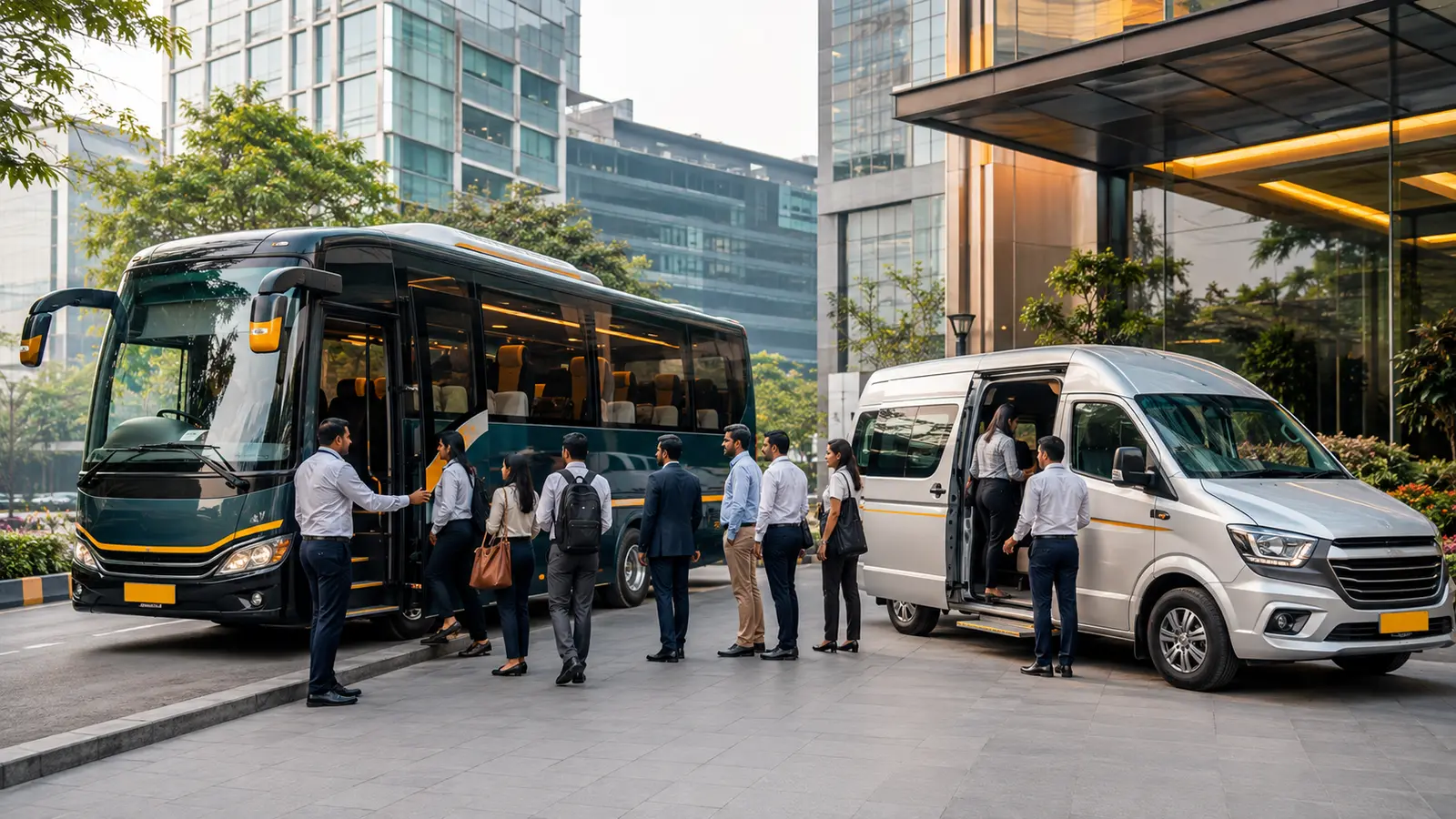
Reliable corporate transport is an operating system for people. When routes, vehicles and communication work together, employees arrive with less uncertainty and business events start with greater control.
Delhi NCR connects offices, industrial areas, technology parks, hotels, airports, conference venues and residential clusters across a wide geography. A team may live in Delhi, Gurugram, Noida, Greater Noida, Ghaziabad and Faridabad while reporting to one office or moving between several sites. That makes corporate employee transportation in Delhi NCR more than a vehicle-booking task. It requires route logic, capacity planning, realistic timing and clear responsibility.
This guide is for HR teams, administration managers, event planners, procurement teams and executive assistants who arrange employee shuttles, conference travel, airport transfers, office off-sites, plant visits and project-based group movement. It explains how to define the requirement, select a fleet, organise pickup points, reduce avoidable delays and prepare a transport brief that suppliers can quote accurately.
Start with the Business Requirement
“We need a bus” is not yet a transport plan. First identify why the group is moving and what a successful movement looks like. A fixed daily staff route needs predictable stops and repeatable timings. A conference shuttle may need high capacity for two short peaks. An off-site requires comfortable outstation travel, while an airport movement depends on flight arrivals and luggage.
Write the requirement in one sentence. For example: “Move 70 employees from three metro hubs to our Gurugram office by 8:45 a.m. on weekdays,” or “Transfer 32 conference delegates from two hotels to Pragati Maidan and return after the event.” A specific objective allows every later decision—vehicle size, departure time, coordinator and contingency—to support the same outcome.
Understand the Main Corporate Transport Models
Fixed employee shuttle routes
These are recurring services between residential or transit hubs and the workplace. They work best when stops are limited, route groups are balanced and boarding rules are consistent. Fixed routes should be reviewed periodically because employee locations, shift times and road conditions change.
Metro-to-office feeder transport
A feeder connects a nearby metro station or transit point to an office campus. It can reduce the complexity of long residential routes and help employees use public transport for the main journey. Frequency and turnaround time matter more than large luggage capacity.
Shift and project transportation
Factories, BPO operations, project sites and event teams may require early-morning, late-evening or rotating shift travel. The plan should clearly show shift reporting times, route handovers and the responsible contact for each movement.
Meetings, conferences and exhibitions
Event transport usually has concentrated arrival and departure windows. Delegates may travel from hotels, airports and offices. A transport desk, vehicle labels and a master manifest can prevent confusion when several groups move at once.
Corporate off-sites and outstation travel
Longer journeys require more attention to seating comfort, rest stops, luggage and driver scheduling. A premium coach can keep the team together and turn travel time into a calmer part of the event.
Choose a Fleet Mix Instead of Forcing One Vehicle
The most efficient plan is not always one large bus. Different routes and passenger groups may need different capacities. A tempo traveller can serve a smaller leadership or project group, an 18-seater coach can connect a compact pickup zone, and 27- to 45-seater coaches can manage larger employee clusters or event movements.
- Review Tempo Traveller rental for smaller teams and flexible group movement.
- Use an 18-seater coach when a compact route needs a coach-style experience.
- Compare the 27-seater and 35-seater coach for medium employee or delegate groups.
- Explore the full bus and coach fleet for higher-capacity requirements and corporate events.
- Consider a Volvo bus on rent in Delhi for premium outstation travel, large delegations or high-comfort movements.
Capacity should include a sensible margin. A route planned at absolute maximum seating becomes fragile when a new employee joins, a stop is consolidated or a bag must travel with the group. For conferences and airport transfers, include luggage in the capacity decision.
Design Pickup Points That People Can Actually Use
Too many stops make a route slow; too few make it inaccessible. The best pickup points are easy to describe, safe for boarding and practical for a bus to approach. Metro stations, recognised commercial landmarks and wide service roads can work, but every location should be checked for legal stopping space and peak-hour congestion.
Avoid stops that require dangerous road crossings or create long detours for a small number of passengers. Share a map pin and a short written description because a pin alone may place people on the wrong side of a road. For a recurring shuttle, use consistent names such as “Gate 2 pickup zone” rather than informal descriptions that change by driver.
Route brief: information to include
- Operating days and reporting time
- Passenger count by pickup cluster
- Exact stops with map pins and boarding-side notes
- Shift, meeting or event schedule
- Vehicle capacity and accessibility needs
- Primary and backup corporate coordinators
- Rules for late arrival, missed pickup and route changes
- Return timing and after-hours escalation contact
Build a Realistic Schedule
A route plan should include boarding time, traffic variability, office entry procedures and a small operational buffer. It should not depend on every road behaving perfectly. Use actual employee arrival data during a pilot period, then adjust departure times based on the recurring pattern.
For events, work backward from the required venue arrival. Include time for people to leave the coach, collect items, complete security checks and walk to the registration area. If 100 delegates must be seated by 9:30 a.m., a 9:25 a.m. vehicle arrival is not a workable target.
Return journeys deserve equal attention. Employees need to know whether the coach leaves at a fixed time, after the last session or when a coordinator gives clearance. Unclear return rules create waiting, duplicate calls and missed passengers.
Make Communication Simple and Controlled
Transport operations become noisy when every passenger calls the driver. Use one corporate coordinator per route or movement. That person should hold the passenger list, driver details, vehicle identification and escalation contact. Employees should receive only the information they need: stop, reporting time, vehicle reference and coordinator number.
For a large conference, create a one-page movement note. List hotel departure times, coach allocation, venue entry point and return plan. If routes change, send one approved update through the same channel. Multiple versions of the schedule are a common source of errors.
Safety and Service Questions to Ask
Safety should be discussed as a practical process rather than a marketing phrase. Ask how vehicles are checked before deployment, how drivers are assigned, what documents are maintained and whom the corporate team contacts if a vehicle issue occurs. For long routes, ask about suitable breaks and scheduling. For recurring services, agree on how substitution vehicles are communicated.
Inspecting a vehicle for a major event can be useful. Check cleanliness, seating condition, air-conditioning, doors, lighting and luggage arrangements. If accessibility support is needed, define it before the booking rather than at boarding time.
Employee Experience Affects Adoption
A transport plan can look efficient on a spreadsheet but fail if employees find it confusing or consistently late. Adoption improves when stops are clear, vehicles are clean, the ride is comfortable and changes are communicated early. Collect structured feedback after the first week or event, asking about punctuality, stop convenience, boarding and comfort.
Avoid solving every complaint by adding another stop. That may make the full route worse. Look for patterns: Is one stop consistently overloaded? Is a route crossing the same corridor twice? Would two smaller vehicles serve different clusters better than one large loop? Good transport design balances individual convenience with system reliability.
Corporate Airport and VIP Movements
Airport pickups require passenger and luggage counts, flight numbers, terminals and realistic exit buffers. When several delegates arrive on different flights, group them by arrival window. A coach can serve the main delegation while a premium car or SUV supports senior leadership or guests with separate schedules. The movements should still share one master plan.
For detailed airport coordination, read the guide to Delhi airport group transfers once published. The same principles—one meeting point, one coordinator and accurate luggage planning—apply to corporate arrivals.
How to Compare Corporate Transport Quotations
Compare like with like. One quotation may include a specific kilometre allowance, reporting time and vehicle category, while another may use different assumptions. Ask each supplier to state the vehicle, capacity, schedule, kilometres, hours, parking, toll treatment, outstation allowances and any additional waiting terms.
Price matters, but so do route suitability, communication and the ability to deliver the agreed capacity. A lower quote for an undersized vehicle can create extra trips, overcrowding or last-minute replacements. Evaluate the full operating plan, not only the headline number.
Common Corporate Transport Mistakes
- Creating a route from addresses without checking practical pickup locations
- Adding too many stops and making the journey unpredictable
- Selecting capacity with no spare seats
- Sharing the driver’s number with every passenger
- Ignoring return logistics until the event ends
- Using one vehicle type for every group despite different needs
- Failing to define the process for delays, substitutions and route changes
- Comparing quotations that are based on different schedules or inclusions
A Simple Implementation Plan
- Define: record the business objective, schedule, passenger clusters and service period.
- Map: identify practical pickup points and expected route durations.
- Match: select a fleet mix with suitable capacity and comfort.
- Pilot: test the route or review the event movement before full operation.
- Communicate: issue one clear schedule and coordinator contact.
- Measure: track punctuality, boarding issues, occupancy and feedback.
- Improve: adjust stops or capacity based on evidence, not isolated requests.
Frequently Asked Questions
What is the best vehicle for employee transportation in Delhi NCR?
It depends on route density and passenger count. Smaller clusters may suit a tempo traveller or 18-seater coach, while larger routes and events may require 27-, 35-, 41- or 45-seater coaches. A mixed fleet is often more efficient than one vehicle type.
Can corporate transport be arranged for a one-day event?
Yes. One-day requirements can include hotel shuttles, airport pickups, conferences, exhibitions, plant visits and off-sites. Share the full movement schedule so arrival and return plans can be coordinated.
How should pickup stops be selected?
Choose safe, recognisable locations that a coach can approach without causing a major detour. Provide both a map pin and a written boarding-side description.
What information is needed for a quotation?
Provide dates, reporting times, pickup points, destinations, passenger counts, route frequency, return schedule, vehicle preferences and any luggage or accessibility needs.
Can Ajay Travels support airport, event and outstation movements?
Ajay Travels presents cars, vans, tempo travellers, buses and coaches for varied group travel needs. Share the complete itinerary so an appropriate combination can be discussed.
Build a Corporate Movement Plan That Works
Send Ajay Travels your passenger clusters, reporting times, pickup points and destination. We will help you review suitable vehicle options for employee routes, meetings, conferences, airport transfers and off-sites.
REQUEST A CORPORATE QUOTE Call 24/7: +91 98101 31530